Axiom Trade is a browser-based Solana trading terminal built for fast-moving memecoin markets. The best reason to use it is Pulse, its discovery workflow for newly created and recently migrated tokens. The trade-off is complexity: active traders tend to love the tighter workflow, while casual users may find it heavier than a simple swap.
If you are searching for Axiom Solana, Axiom Trade, or an Axiom trading bot, the key distinction is this: Axiom is best understood as a full trading terminal, not a passive bot that trades for you.
Quick verdict
Axiom Trade review 2026: overview
Axiom is a web-based Solana trading terminal that combines token discovery, analytics, social monitoring, and execution in one interface. For searchers comparing Solana memecoin trading terminals, the core question is whether Axiom reduces the time between finding a token, checking context, and executing a trade.
On the legitimacy question, Axiom is backed by Y Combinator and is widely described as one of the higher-volume Solana terminals in its category. That is a credibility signal, not a safety guarantee, and it sits alongside the structural risks covered further down.
For active traders, the appeal is straightforward: fewer tabs, faster reactions, and better visibility on new launches. For newer traders, the trade-off is just as clear: the interface is built for speed, not simplicity.
How we reviewed Axiom: this review is based on hands-on use of the terminal — live Pulse sessions filtering new pairs by sniper %, holder concentration, and migration state; test trades through Instant Trade using the Pulse discovery flow; review of the wallet manager, KOL tracker, and signup flow. The fee math in this review is verified against Axiom's official docs. Figures not published in official docs (perps, yield) are clearly marked as third-party and flagged for in-app confirmation.
Axiom is a trading terminal, not a trading bot. It is built around a full-screen visual workflow rather than chat commands.
Unlike Telegram bots that operate through chat commands, Axiom gives you a browser-based workspace with charts, discovery, and execution side by side. So if you arrived searching for an “Axiom trading bot,” the accurate mental model is a hands-on terminal you drive yourself, not an automated bot that trades while you sleep.
 Pulse
PulseWhat is Axiom Pulse and how does it work?
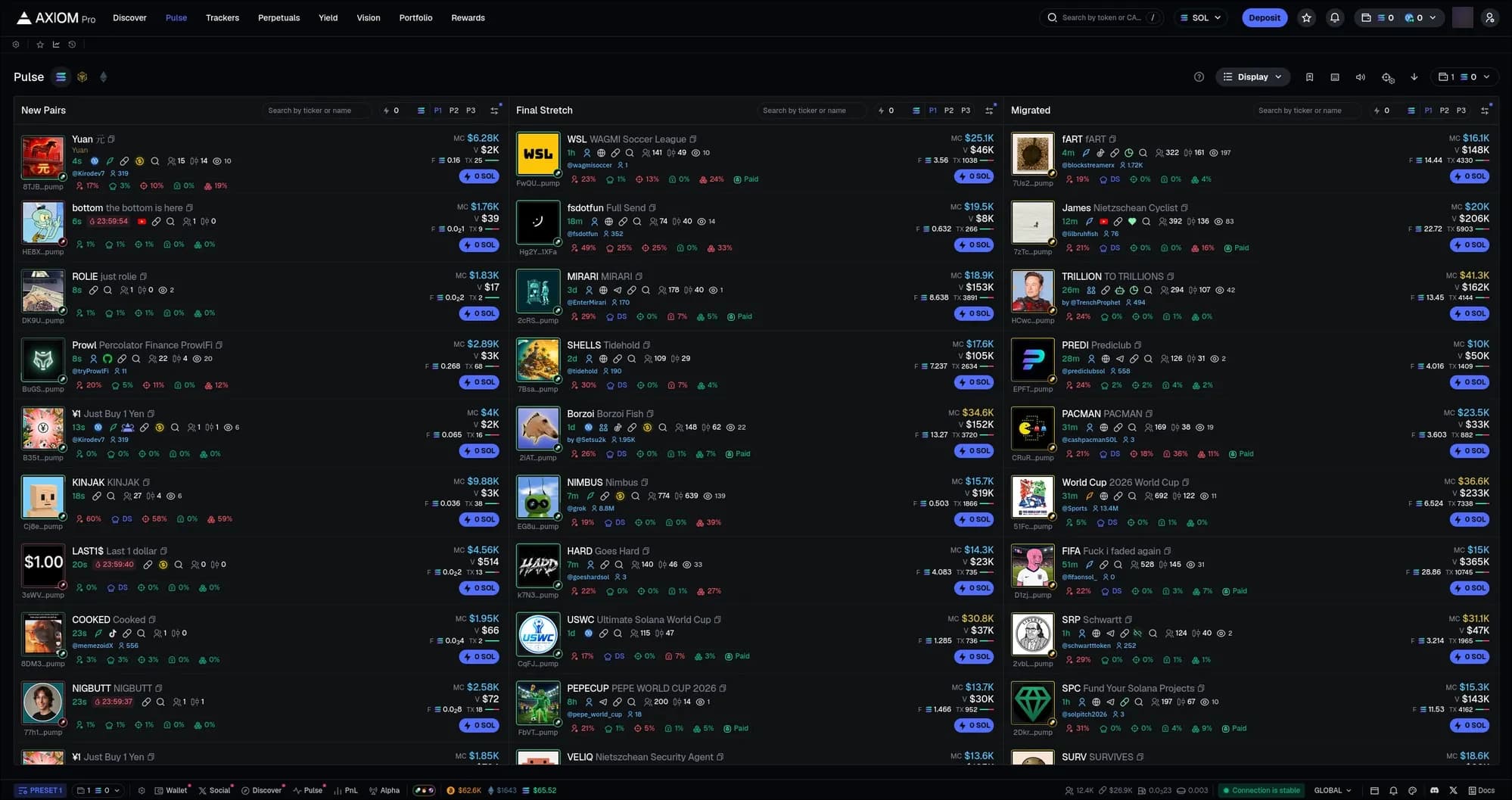
Axiom Pulse is the platform's live discovery feed for Solana token launches: it groups tokens into new creations, final-stretch tokens nearing migration, and tokens that just migrated to Raydium, so you can scan the early lifecycle in one place instead of across several tools.
Its filters let you sort and screen by signals such as token age, liquidity, sniper percentage, and top-holder concentration, so you can skip the obvious traps before you ever open a chart.
- New Creations: a fast view of tokens that were just created.
- Final Stretch: tokens nearing the end of their bonding curve before migration.
- Migrated to Raydium: a clean way to watch fresh listings once liquidity moves onchain.
The real value is not “magic alpha.” It is workflow compression. Instead of checking multiple tools for launches, migration state, and liquidity, Pulse turns that into one repeatable scan.
How to use Pulse without getting farmed
Pulse can help you see opportunities earlier, but it can also tempt you into chasing every fresh pair. A safer way to use it:
- Start with migrations, not just creations: recently migrated pairs tend to have clearer liquidity than brand-new noise.
- Check holder concentration first: if supply is too concentrated, early discovery will not save you from bad structure.
- Use size discipline: treat first entries as probes, not conviction bets.
- Watch wallet and social context together: a chart alone is not enough when memecoins move on attention.
- Assume misses are normal: the goal is a better process, not catching every launch.
Core features
Axiom works because it pulls discovery, signals, analytics, and execution into one place. These are the features that matter most when speed and awareness decide whether a trade is early or late.
 Instant Trade
Faster trade workflow, not just faster charts
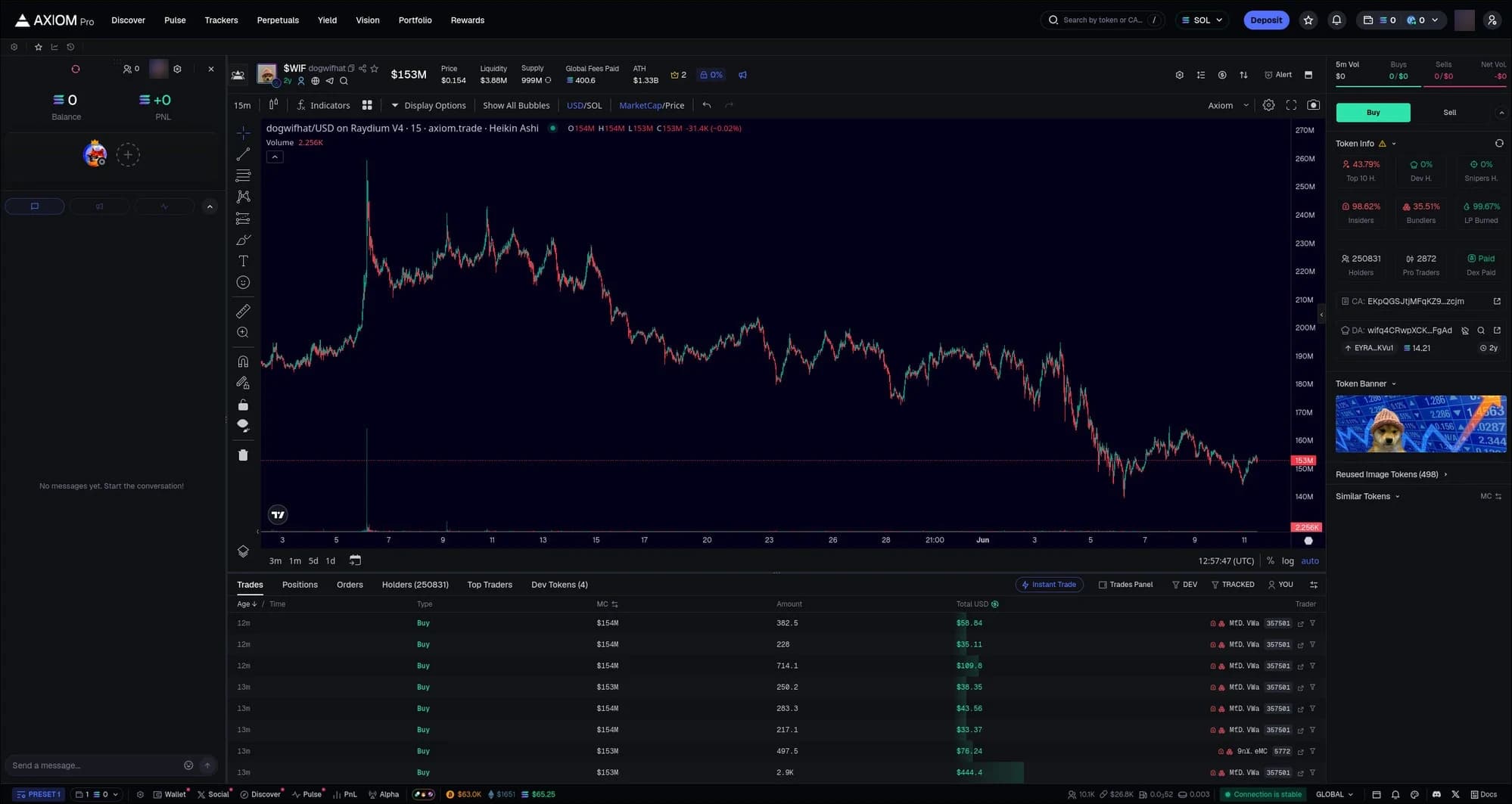
Speed matters in memecoin trading, but the more useful question is whether a terminal helps you act with fewer steps. Axiom's value here is its trading workflow: quick-buy actions inside Pulse, Instant Trade, hotkeys, and configurable MEV modes for Solana execution.
- Instant Trade: buy and sell from a compact panel instead of rebuilding your setup every time.
- Quick Buy in Pulse: act on new opportunities from the discovery table itself.
- MEV modes & Solana fee controls: more control over how aggressive or defensive your execution is.
 Signals
Social signals inside the terminal
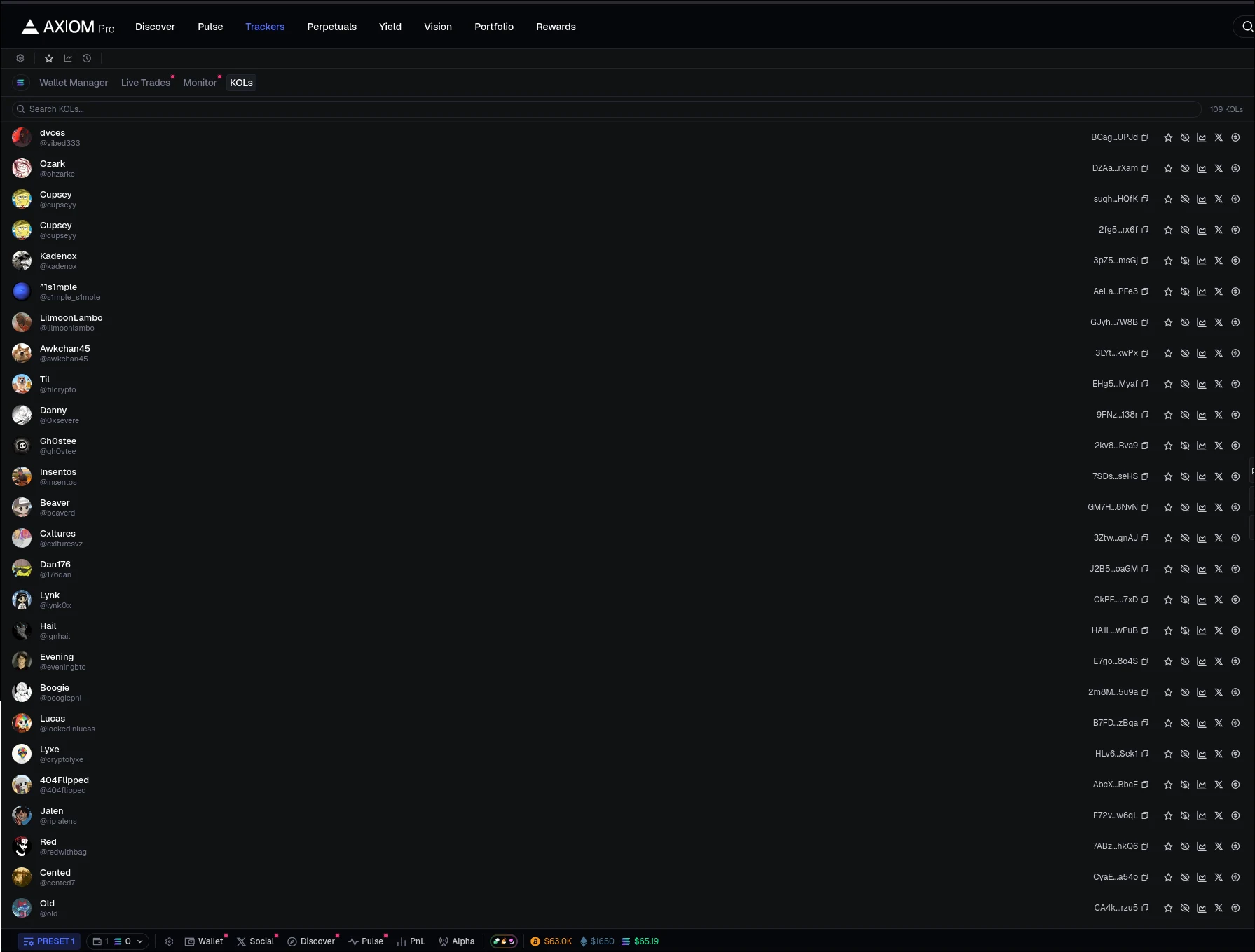
Memecoins move on attention as much as charts. Axiom brings social monitoring directly into the terminal, so you spend less time bouncing between X, DexScreener, and separate wallet tools.
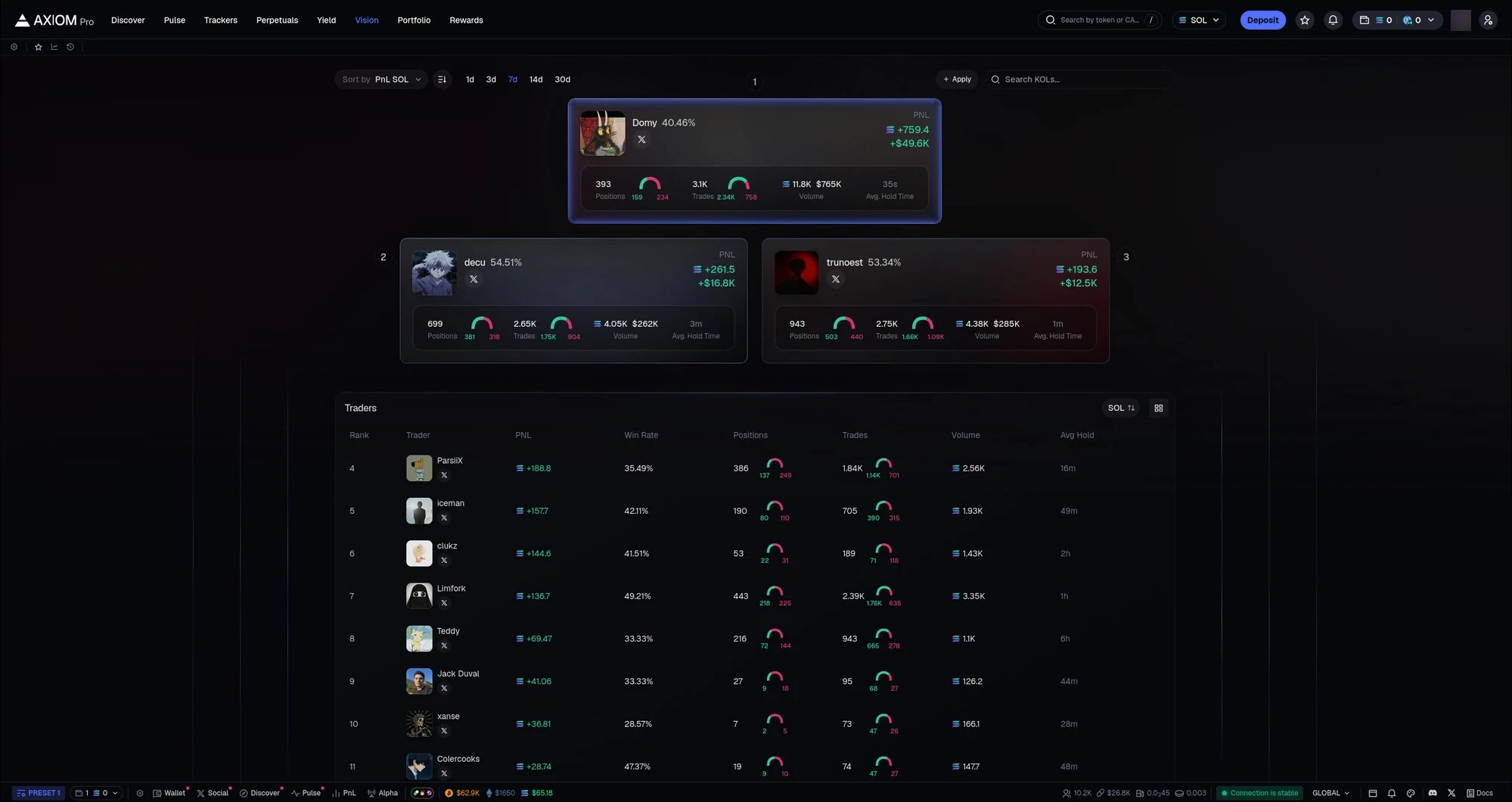
- Wallet Tracking: monitor wallets you care about without leaving the terminal.
- Tweet Monitor: pull relevant X posts into the workflow when attention is moving faster than charts.
- Chart-Side Context: keep wallet, social, and price context closer together while deciding.
 Analytics
Deep analytics & charts
Axiom gives traders a deeper read on tokens than a basic price chart alone.
- Holder distribution: see how supply is distributed across wallets.
- Volume & liquidity tracking: monitor real-time activity and liquidity depth.
- Smart money tracking: follow wallets with stronger track records.
- Custom indicators: add chart context when basic price action is not enough.
- Token screening: filter tokens by the criteria that matter to your workflow.
Axiom is no longer only a spot terminal. It now layers in perpetual futures and a yield / earn product alongside discovery and execution — see the Pro, Yield & Perpetuals section below.
How to use Axiom Trade (quick start)
Getting started on Axiom follows a predictable order. The steps below describe the typical flow as documented across Axiom's onboarding and third-party guides as of June 2026; the exact screens can change, so follow the in-app prompts.
- Connect a wallet or log in: reach Axiom from the official axiom.trade domain and start the account or wallet-connect flow.
- Save your recovery key: record the recovery key or phrase offline before you do anything else — a non-custodial account means nobody can restore access for you.
- Fund with SOL: deposit SOL into your Axiom wallet, or use the in-app Buy Crypto on-ramp.
- Find a token: use Pulse or search to locate a pair, and learn to vet a token before committing real size.
- Set slippage and MEV mode: match them to how volatile the pair is. Too-tight slippage fails fast pairs; too-loose slippage invites bad fills.
- Place the trade with Instant Trade: execute from the Instant Trade panel or a Quick Buy button, starting with a small probe size until the workflow feels familiar.
Execution settings do a lot of the work here. Learn what your slippage, priority fee, and MEV mode actually do on a tiny trade before you size up — a bad fill is often a settings problem rather than a platform problem.
Is Axiom safe and legit?
This is the question most people actually want answered before signing up, so here is a straight take.
Axiom is a legitimate, widely used Solana trading terminal, it is backed by Y Combinator, and it is non-custodial — you keep control of your own funds and approve every transaction yourself. That removes the single biggest risk of handing assets to a third party. It does not remove the risk of trading itself, and it does not make Axiom a regulated or insured venue.
What “safe” really means here:
- Non-custodial by design: your keys and funds stay under your control; Axiom cannot move your assets on its own. Wallet access is handled with hardened, enclave-based key infrastructure (Turnkey).
- You approve each trade: responsibility for what you sign sits with you — good for control, but you must read prompts carefully.
- The real risks are operational: phishing clones, signing a malicious transaction, fat-fingering size, and the extreme volatility of new tokens. None of these are unique to Axiom.
- Structural caveats: Axiom is unregulated, with no insurance or recourse fund. Access is geoblocked in the United States, China, Singapore, Cuba, Iran, Iraq, North Korea, Syria, and Yemen as of June 2026 — if you are in one of these regions, the platform is not available to you. Public sentiment is thin and split (a small, polarized Trustpilot profile as of June 2026, with recurring complaints about slow Discord-only support). Also note the Solana terminal at axiom.trade is unrelated to the similarly named axiom-trade.pro forex namesake — make sure you are on the right site.
Only ever open Axiom from the official axiom.trade domain, bookmark it, double-check token contracts before buying, start with a small amount until you trust your setup, and treat every memecoin trade as high-risk regardless of the platform.
Withdrawals & deposits
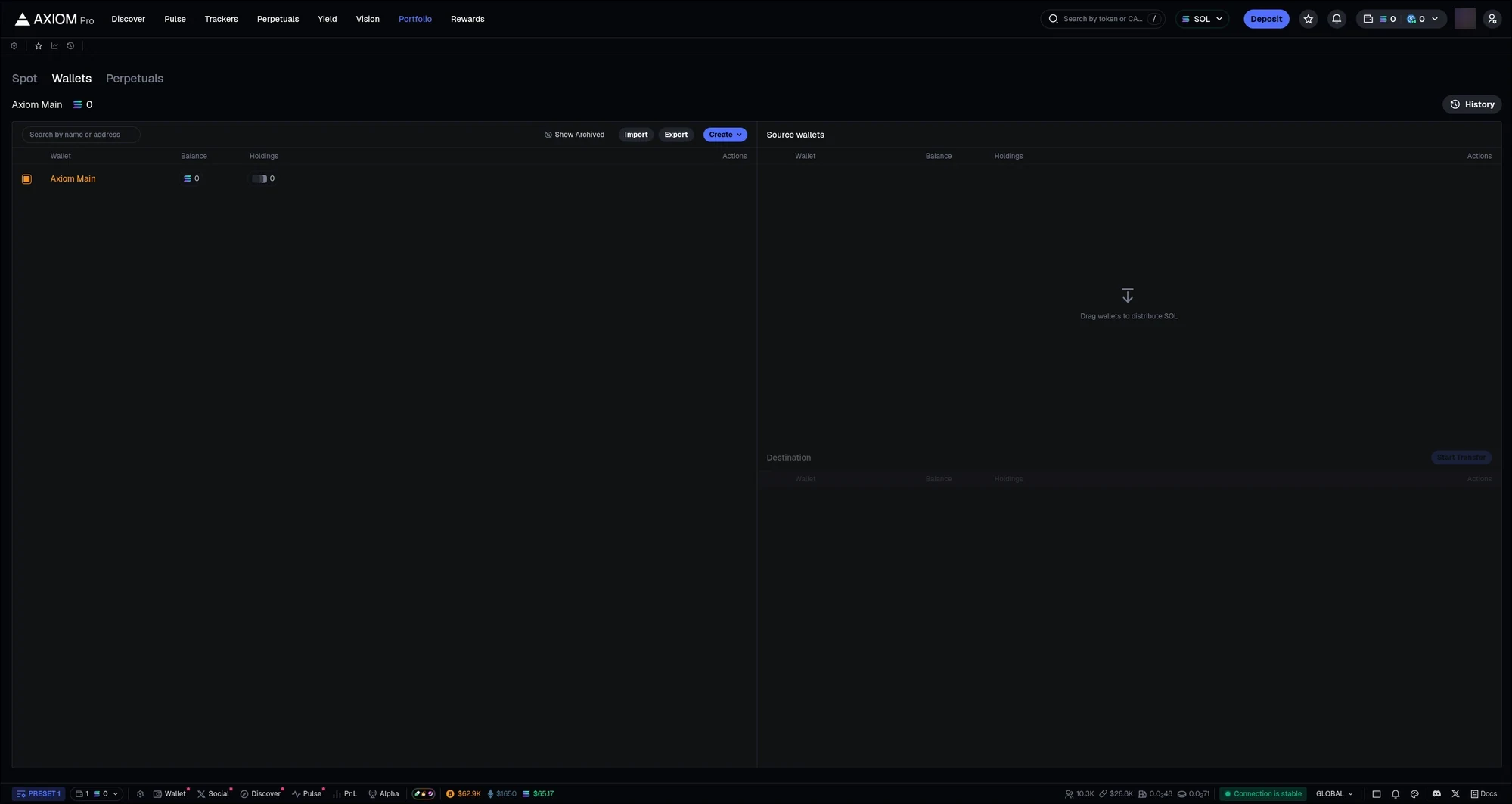
Funding and withdrawal on Axiom follow directly from the non-custodial model. There is no Axiom wallet you are depositing into — you are funding and managing your own wallet.
- Minimum deposit: none — you fund your own wallet with as little SOL as you like.
- Withdrawal cost: no separate Axiom withdrawal fee beyond the standard Solana network fee, since you are moving funds from your own wallet.
- On-ramp options: card and Coinbase on-ramp funding is available in-app. Confirm current availability and limits on the platform.
- No custody, no lock-up: because Axiom does not hold your assets, there is no withdrawal queue, no approval process, and no minimum withdrawal threshold.
Withdrawing is just moving SOL from your Axiom-managed wallet to any external address — it is a standard Solana transaction. The wallet manager lets you manage multiple wallets and transfer between them directly.
Axiom fees (full tier breakdown)
Axiom Trade charges a net trading fee of 0.95% at entry (Wood tier) down to 0.75% at Champion tier, with no monthly subscription. All tiers include SOL cashback that partially offsets each trade.
Instead of a recurring fee, Axiom uses a pay-per-trade model with SOL cashback that improves as your volume climbs. For many traders that cost model is easier to justify than a subscription — but it rewards higher-volume users more than casual ones.
Per Axiom's official fee documentation (June 2026), the headline swap fee is effectively 1% gross, which nets to 0.95% at the entry Wood tier after a 0.05% cashback, and improves down to a 0.75% net at the top Champion tier. The seven tiers are volume-based — your multiplier rises with total trading volume — though the exact thresholds are not published.
| Tier | Net trading fee | SOL cashback |
|---|---|---|
| Wood (1X) | 0.95% | 0.05% |
| Bronze (2X) | 0.90% | 0.10% |
| Silver (2.5X) | 0.875% | 0.125% |
| Gold (3X) | 0.85% | 0.15% |
| Platinum (3.5X) | 0.825% | 0.175% |
| Diamond (4X) | 0.80% | 0.20% |
| Champion (5X)Best rate | 0.75% | 0.25% |
What a trade actually costs (all-in)
- $1,000 at Wood: platform fee $9.50 net (0.95%) + ~$0.20–$0.50 Solana priority fee at current SOL prices = ~$9.70–$10.00 total.
- $5,000 at Wood: platform fee $47.50 net (0.95%) + ~$0.20–$0.50 priority fee = ~$47.70–$48.00 total.
- $5,000 at Gold: platform fee $42.50 net (0.85%) — about $5.00 cheaper than Wood on the same trade.
- Account initialization (one-time): creating your internal trading account costs approximately 0.016 SOL (~$2–$3 at typical prices). This is a one-time cost, not a recurring fee.
Perpetuals fees are not on Axiom's official fee page (third-party reviews cite ~0.01% per trade via Hyperliquid). Solana network and priority fees (commonly ~0.001–0.005 SOL) are separate and apply to every transaction. Priority fees vary with network congestion. Whether the 10% referral discount stacks on the net fee is also undocumented — confirm it on the signup screen.
Fee structure notes
- No monthly subscription fees
- Pay-per-trade pricing only
- Volume-based tier progression (seven tiers)
- SOL cashback on all trades, rising with your tier
- Solana network and priority fees are separate
- ~0.016 SOL one-time account initialization fee
Axiom vs Photon, BullX and GMGN
Most traders evaluating Axiom are also looking at the other Solana terminals. Here is a high-level comparison to frame the decision. Verify current details on each platform, since features and fees move quickly.
| Platform | Type | Typical fee | Best for |
|---|---|---|---|
| Axiom | Web terminal (non-custodial) | Net 0.95%→0.75% + cashback | Discovery (Pulse) + execution in one fast workflow |
| Photon | Web terminal (non-custodial) | ~1% typical | Raw execution speed on an established platform |
| GMGN | Web + bot (non-custodial) | ~1% typical | Automation and copy-trading over manual discovery |
| BullX | Web terminal (non-custodial) | ~1% typical | A familiar multichain terminal workflow |
| Trojan | Telegram bot (non-custodial) | ~1% typical | Low-friction trading from chat, not a full terminal |
Axiom vs Photon
Photon is Axiom's closest direct competitor and many active traders use both: Axiom for research, filtering, and entry via Pulse; Photon for exits and chart-driven execution. Photon routes through Jito for sub-second fills and its interface is stripped down by design. What Photon lacks is any discovery layer equivalent to Pulse — there is no equivalent feed for filtering new launches by sniper %, holder concentration, or migration stage. Axiom also supports event-based entry triggers and configurable MEV modes that Photon does not expose at the same level. Fee structures are broadly similar (~1% gross on both); the practical difference is workflow fit, not cost.Axiom vs BullX
BullX is a multichain web terminal that covers chains beyond Solana. Its interface is familiar to traders who have used web DEX terminals before, and it supports copy-trading features Axiom does not have. Axiom's advantage is depth on the Solana-specific side: Pulse has no BullX equivalent, and Axiom's signal layer (tweet monitor, KOL tracker, whale alerts) is more integrated. If you trade primarily Solana memecoins and want the fastest discovery workflow, Axiom edges BullX. If multichain breadth matters, BullX has the wider reach.Axiom vs GMGN
GMGN leans into automation and copy-trading in a way Axiom does not — it lets you mirror smart-money wallets automatically, which appeals to traders who want less manual involvement. Axiom is a hands-on terminal; it is not designed to trade while you sleep. The trade-off is control: GMGN's automation means less decision-making, but also less ability to customize entries, size risk precisely, or use Pulse-style discovery signals before acting. For the dedicated head-to-head with Photon — discovery, fees, custody, and which wins for your workflow — read our Axiom vs Photon comparison.Axiom Pro, Yield & Perpetuals: what they actually are
A few Axiom-related terms cause confusion, so here is what they actually mean.
Is “Axiom Pro” a different product? No. “Axiom Pro” is a colloquial name for the same Axiom Trade platform — not a separate paid tier, a different app, or a token. If a search result points you to “Axiom Pro,” it is the same terminal covered in this review.
Beyond spot trading, Axiom has added more products:
- Yield / earn: third-party reviews cite a lending or earn product in the range of roughly 5–15% APY. This is not on Axiom's official fee page — confirm the current terms in-app before depositing.
- Perpetual futures: third-party reviews cite perps powered by Hyperliquid with up to 50x leverage and a fee around 0.01% per trade. These figures are not on Axiom's official fee page either — confirm in-app. Leverage cuts both ways and can liquidate a position quickly, so size it conservatively.
What to test before your first real trade
If you actually want to know whether Axiom is worth using, do not judge it from screenshots. Test the workflow in this order:
- Create the account and secure recovery access: understand the wallet/recovery flow before funding anything.
- Fund lightly first: start with a small amount of SOL and confirm balances, swaps, and settings behave as expected.
- Open Pulse and a migrated pair: the fastest way to feel whether the discovery workflow is genuinely useful to you.
- Try Instant Trade with tiny size: learn the interface before you need it under pressure.
- Review fees and MEV settings: check your fee tier and MEV mode before you size up — they materially change your fill.
Do not aim to make money on day one. Aim to understand the flow well enough that your first real trade does not feel like a UI experiment.
Who should use Axiom?
Good fit
- Active Solana memecoin traders
- Frequent traders who want speed and awareness
- Users seeking advanced analytics and discovery
- Traders requiring fast execution
Less ideal for
- Complete beginners to cryptocurrency
- Casual, infrequent traders
- Users who prefer a simple swap interface
- Long-term holders only
What changed for Axiom in 2026
This review was last updated in June 2026. The notable shifts since launch: Axiom expanded beyond Solana spot into perpetual futures and multichain trading, while keeping Solana memecoins as its core use case.
The seven-tier fee and SOL-cashback system (net 0.95% down to 0.75%) is current as of June 2026 per Axiom's official docs, and the referral terms — a documented 10% new-user discount with a 30/3/2 referrer revenue split — are current as of the same date. Figures that are not on Axiom's official fee page (perps, yield) remain third-party and should be confirmed in-app.
Conclusion
Axiom is one of the better Solana trading terminals for traders who move fast in memecoin markets. The combination of Pulse discovery, fast execution, and integrated signals genuinely reduces friction — fewer tabs, faster reactions, and better context when it matters.
The non-custodial model is a real advantage, but it still puts responsibility on you to understand what you are signing and why, and it comes without the insurance or recourse a regulated venue would offer. The fee structure also makes more sense if you trade often enough to benefit from the better tiers.
If you are deep in Solana memecoins and want a faster, more connected workflow, Axiom is easy to justify. If you are new, trade rarely, or prefer something stripped down, it may feel like more terminal than you actually need. The best reason to try it is not hype around “being early” — it is whether the product gives you a cleaner decision loop: discovery, context, execution, and risk controls in one place.
Ready to try Axiom?
Axiom is a browser-based terminal: you sign up on its official site.
Explore next
Move from tool research into live Solana memecoin pages, charts, and links.